
Demonstrasi yang Berpindah dari Parlemen ke Ruang Tamu
Curator: Syarifa Amira Satrioputri
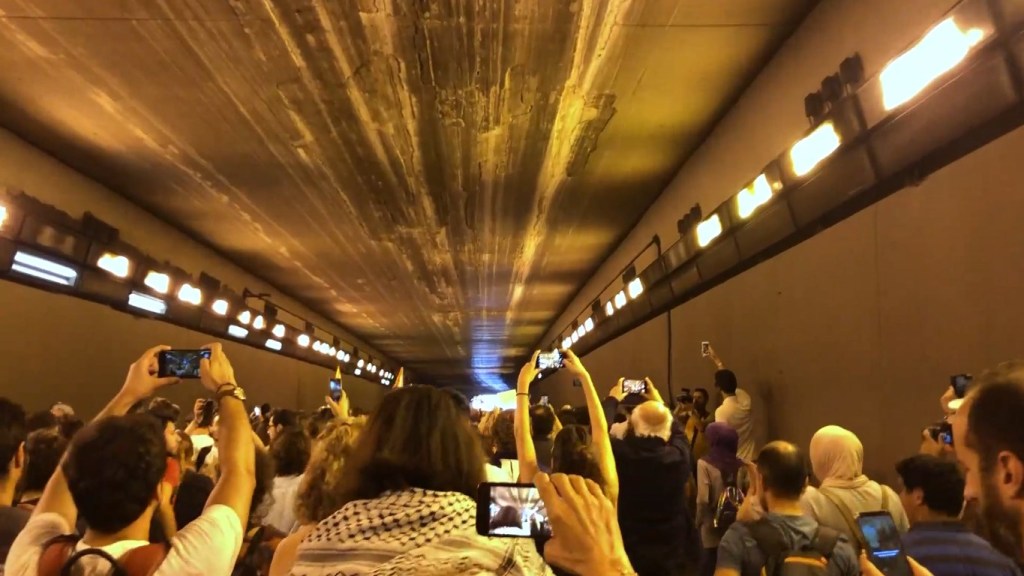
Revolusi Lebanon 17 Oktober 2019—demonstrasi besar-besaran yang bermula di ruang publik, jalanan, dan gedung parlemen—menjadi simbol perlawanan terhadap krisis politik dan ekonomi. Namun, ketika pandemi COVID melanda, demonstrasi terpaksa bergeser ke ruang domestik. Pergeseran ini bukan sekadar perubahan lokasi, melainkan juga transformasi strategi politik yang merembes ke ranah privat. Ruang privat pun berubah fungsi menjadi arena politik terselubung ketika represi dan situasi menyingkirkan massa dari jalanan.
Negosiasi politik melalui cara frontal jarang berjalan mulus. Faktor tak terduga, termasuk yang non-politis, kerap menginterupsi lajunya. Situasi inilah yang tergambar dalam Revolusi Lebanon 2019—yang menjadi pokok wacana film Night is Day (2024) karya Ghassan Salhab. Epik berdurasi sekitar enam jam ini merekam aksi massa di kota-kota besar Lebanon sejak awal revolusi hingga terhenti akibat pandemi COVID. Aturan karantina menutup peluang massa untuk merumuskan ulang visi kolektif; energi yang semula tumpah di jalan tak sempat merespons isolasi paksa.
Alih-alih dokumenter jurnalistik, Night is Day bekerja layaknya jurnal reflektif yang menyoroti rumitnya dinamika politik dalam bayang-bayang isolasi. Salhab menegaskan posisi sinema bukan sekadar tumpukan data dan dokumentasi, melainkan ruang afektif yang membangun resistensi melalui lapisan pengalaman. Lewat pengalaman menonton, film ini merambah ruang afektif penonton—menghadirkan respon tubuh terhadap tiap adegan dan membangkitkan kepekaan inderawi. Penonton dipaksa merasakan revolusi yang berlarut-larut, intensitas peristiwa kecil yang terlewat sejarah, dan keputusasaan di balik pagar penutup jalan. Dengan durasi tak lazim, film ini menyingkap getir perjuangan—rasa geram dan kecewa ketika revolusi terhenti di batas politik dan gagal bereskalasi.
Selain menghadirkan ketegangan de-eskalasi yang dibangun secara sinematik, Night is Day melempar pertanyaan mendasar tentang makna revolusi. Haruskah revolusi dipahami sebagai resistensi kolektif yang heroik dan “romantis”? Ataukah ia dapat terurai melalui gestur kecil di ranah privat? Pertanyaan ini ditegaskan lewat pembabakan film: tiga jam pertama menampilkan beban demonstrasi besar di ruang publik, sedangkan tiga jam berikutnya memerangkap penonton dalam aktivitas sang sutradara selama pandemi.
Baik bagian awal maupun akhir film sama-sama tak menawarkan kenyamanan. Setelah melewati adegan brutalitas aparat dan demonstrasi tanpa akhir, tiga jam terakhir tetap menolak memberi jeda, meski dengan bentuk yang lebih subtil. Di sinilah pernyataan krusial sang sutradara: revolusi tidak terikat pada skala atau medium tertentu; ia bisa bermetamorfosis dari massa ke individu, dari demonstrasi ke keseharian, dari ruang parlemen ke ruang tamu.
Demonstrasi tidak lenyap sejak Revolusi Lebanon terhantam pandemi, melainkan berpindah medan—dari melawan institusi negara menjadi melawan institusi yang lebih kecil: keluarga, memori, keseharian, dan gaya hidup yang dibentuk ekonomi modern. Salhab menampilkan daftar tuntutan ini lewat visual rumah: mengecek cuaca dari jendela, bermain dengan kucing, hingga dialog pribadi tentang ibunya. Ia membongkar ilusi bahwa politik hanya hidup di ruang publik.
Pembabakan film terasa proporsional, dengan durasi ruang publik dan ruang privat yang seimbang. Night is Day tidak menolak elegi melankolia pasca revolusi, namun juga tak mengamini anggapan bahwa ruang privat adalah kevakuman tanpa potensi perlawanan. Ruang tamu menjadi medan konflik yang tak pernah padam—dapat bertumbuh, rapuh, atau bergeser sesuai agensinya. Sesuai judulnya, teriakan massa tak mengenal malam dan siang.
Night is Day berangkat dari dokumentasi nyata proses perjuangan, namun melampaui capaian jurnalistik—menjadikan film sebagai medan konflik yang dapat dialami. Di tengah politik brutal dan arus modernisme, sinema hadir sebagai jembatan resistensi baru—mempertemukan ruang publik dan privat dalam satu medium yang sebelumnya dianggap terpisah. Film ini menangkap paradoks itu, membuktikan sinema mampu meleburkannya menjadi pernyataan politis. Sebab melawan di dalam kamar berarti memadamkan api, sedangkan turun ke jalan bisa membakar tubuh sendiri. Sinema hadir untuk menyalakan api yang tak lekang oleh waktu.
The Lebanese Revolution of October 17, 2019—a massive demonstration that began in public spaces, streets, and parliament buildings—became a symbol of resistance against political and economic crises. However, when the COVID pandemic hit, demonstrations were forced to shift to domestic spaces. This shift was not merely a change of location, but also a transformation of political strategy that penetrated the private domain. The private space also changed its function to become a covert political arena when repression and circumstances drove the masses from the streets.
Throughout history, major events such as revolutions have often been framed as singular phenomena that instantly transform social systems. In reality, such events are always linked to dimensions of time, momentum, and the accumulation of ongoing conflicts. Moreover, the actors involved—whether those challenging authority, those being challenged, or those who eventually seize power—are never static, neither before nor after the revolution. This is evident in Lebanon, where the revolution did not occur overnight and triumph the next day. There is a long accumulation of Lebanese history, from colonization to contemporary economic collapse, that erupted into a collective outburst of anger.
Political negotiations through direct confrontation rarely run smoothly. Unpredictable factors, including non-political ones, may interrupt the process. This is the situation depicted in the 2019 Lebanese Revolution—the central theme of Ghassan Salhab’s film Night is Day (2024). This epic, approximately six hours long, records mass actions in Lebanon’s major cities from the beginning of the revolution until it was halted by the COVID pandemic. Quarantine rules closed off opportunities for the masses to redefine their collective vision; the energy that had previously spilled onto the streets did not have time to respond to forced isolation.
Rather than a journalistic documentary, Night is Day operates like a reflective journal that highlights the complexities of political dynamics in the shadow of isolation. Salhab emphasizes that cinema is not merely a collection of data and documentation, but also an affective space that builds resistance through layers of experience. Through the viewing experience, the film penetrates the audience’s affective space—evoking bodily responses to each scene and heightening sensory awareness. The audience is forced to feel the worn-out revolution, the intensity of small events overlooked by history, and the despair behind the roadblock. With its unusual duration, the film reveals the bitterness of struggle—the anger and disappointment when the revolution stops at the political boundary and fails to escalate.
In addition to presenting cinematic de-escalation tension, Night is Day raises fundamental questions about the meaning of revolution. Should revolution be understood as heroic and “romantic” collective resistance? Or can it be unraveled through small gestures in the private sphere? This question is emphasized through the film’s structure: the first three hours depict the weight of large-scale demonstrations in public spaces, while the following three hours trap the audience in the director’s activities during the pandemic.
Both the beginning and end of the film offer zero comfort. After enduring scenes of police brutality and endless demonstrations, the final three hours refuse to provide a break, despite taking a more subtle form. Here lies the director’s crucial statement: revolution is not bound by scale or medium; it can metamorphose from the masses to the individual, from demonstrations to everyday life, from the parliamentary to the living room.
Demonstrations have not vanished since the Lebanese Revolution was hit by the pandemic, but rather shifted their focus—from opposing state institutions to opposing smaller institutions: family, memory, daily life, and lifestyles shaped by the modern economy. Salhab presents this list of demands through visual representations of home: checking the weather from the window, playing with cats, and private conversations about his mother. He dismantles the illusion that politics only exists in public spaces. The film’s structure is well proportioned, with equal durations of public and private spaces. Night is Day does not reject the post revolution melancholia elegy, but it also does not agree with the notion that private spaces are a vacuum without the potential for resistance.
The living room is a battlefield that never dies down—it can grow, become fragile, or shift according to its agency. As the title suggests, the cries of the masses know no night or day. The living room becomes a conflict zone that never ceases—it can grow, be fragile, or shift according to its agency. As the title suggests, the crowd’s cries know no night or day.
Night is Day is based on real documentation of the struggle, but goes beyond journalistic achievements—turning film into a conflict zone that can be experienced. Amidst brutal politics and the tide of modernism, cinema emerges as a new bridge of resistance—bringing together public and private spaces in a medium that was previously considered separate. This film captures that paradox, proving that cinema can fuse it into a political statement. For resisting within the limit of a room means extinguishing the flame, while taking to the streets can burn one’s own body. Cinema exists to ignite a flame that endures through time.
Films
Curator’s biography
Syarifa Amira Satrioputri (2000, Jakarta) adalah pengamat geologi dan seniman multidisiplin. Ia lulus dari jurusan geologi Universitas Indonesia dan aktif mengkaji isu antroposen lewat pemetaan interdisiplin. Penelitiannya tentang lingkungan pengendapan akibat pintu air Manggarai dipamerkan di Zone2Source, Belanda bersama milisifilem. Sekarang ia membangun platform alternatif Geology made Punk (GMP) untuk mengkritisi keilmuan geologi dan menulis tentang film dan lingkungan.
Syarifa Amira Satrioputri (2000, Jakarta) is a geologist and multidisciplinary artist. She graduated from the University of Indonesia with a degree in geology and actively studies the Anthropocene through interdisciplinary mapping. Her research on the sedimentary environment caused by the Manggarai floodgate was exhibited at Zone2Source in the Netherlands with milisifilem. She is currently building the alternative platform Geology made Punk (GMP) to critique geological study and write about film and the environment.


