Membaca Strategi Laurent Van Lancker: Exquisite Corpse Pembentuk Dunia
Curator: Luthfan Nur Rochman
Di titik mana saja dalam sejarah manusia yang dapat kita tegaskan sebagai momen penentu dalam perpindahan manusia? Kita mengenal hipotesis Out of Africa yang meneorikan penghunian-penghunian manusia yang keluar dari benua Afrika, peristiwa aktual Columbian Exchange (tibanya ekspedisi Colombus di benua Amerika di abad ke-15) dan kini Arab Spring (masa penjatuhan rezim-rezim Timur Tengah yang melahirkan banyak perang sipil di abad ke-21), atau yang disebut dalam kitab suci seperti Wisnu yang menjelma kura-kura dan menyelamatkan manusia dari kehancuran atau eksodus Bani Israil, yang kesemuanya menjadi basis dari pembentukan imajinasi kolektif atas dunia atau worldbuilding. Imajinasi kolektif ini memicu perubahan orientasi dalam pemikiran tentang kemanusiaan, melahirkan kekerasan yang disistematisasi atas nama pencerahan dan peradaban.
Kolonialisme merangsek masuk merusak tatanan dan epistemologi warga yang selama berabad belajar mengelola konflik dan membangun relasi bersama lokusnya. Modus kolonialisme, yang berlanjut hingga Perang Dingin, adalah kompartementalisasi atau mengkotak-kotakkan. Ekspresi-ekspresi vernakular dikotak-kotakan ke dalam takhayul, bid’ah, dan omong-kosong. Kekayaan ekspresi worldbuilding yang mencakup narasi dan daya konstruksi narasi itu direlegasi menjadi memori kolektif yang laten, dapat dipanggil sewaktu-waktu, namun kadang dilupakan sepenuhnya. Preservasinya menjadi metode perlawanan pada kekuatan besar, nyaris mistis. Kolonialisme membuat kisah-kisah dunia-dunia ini menjadi linier dan manunggal. Kisah-kisah menjadi konvergen, membangun sejarah modern peradaban manusia.
Di titik tak terhindarkan ini, kita menyimak kedatangan media rekam dari lokus para kolonial yang memberikan modus baru dalam konstruksi narasi ini. Film We Others besutan Laurent Van Lancker bekerja dengan modus yang menarik dalam menghimpun konvergensi kisah perpindahan ini, yaitu Exquisite corpse. Exquisite corpse, atau cadavre exquis dalam bahasa Prancis, merupakan sebuah metode yang lahir dari gerakan seni Surealisme di Eropa awal abad ke-20, di mana kata-kata atau imaji-imaji disusun secara bergiliran oleh individu-individu dalam sebuah kelompok. Metode ini digunakan untuk menekankan intuisi dan peluang-peluang kejutan yang terjadi dalam penciptaan bersama ini, membebaskannya dari regulasi sosial dan moral yang membebani individu dan memunculkan alam bawah sadar yang jujur dalam membaca fenomena dunia, yang menjadi kredo dari gerakan seni ini. Film We Others mengutilisasi tumpukan kesaksian personal para migran kontemporer di atas wahana yang membawa mereka menuju suaka, bersilang sengkarut dengan kesaksian-kesaksian migran di awal abad ke-20 dan arsip-arsip perpindahan.
Praktik Laurent Van Lancker sebagai seorang sineas sekaligus antropolog memandunya untuk memilih jalur shared-authorship. Ia berefleksi dari praktik sineas-cum-antropolog lainnya, Jean Rouch, yang memperkenalkan shared-anthropology dalam film penting sinema dunia Chronique d’un été (Chronicle of a Summer) yang memperlihatkan subjek audiens menilai representasi yang dibuat para sineas. Dalam film pertamanya, Surya (2006), Van Lancker mengutilisasi metode shared-authorship-nya untuk membentuk sebuah dokumenter indrawi (sensorial documentary) lewat strategi asynchronicity atau ketidakserentakan (144). Ketidakserentakan mengacu pada artikulasi hubungan unik bunyi dan imaji yang mengarah pada pengalaman dan pengetahuan indrawi lewat sinema. Surya menjadi prototipe film Van Lancker yang mengutilisasi kolaborasi para pencerita lintas lokasi dan kebudayaan dan ketidakserentakan menjadi metode permainan kode-kode sinemanya.
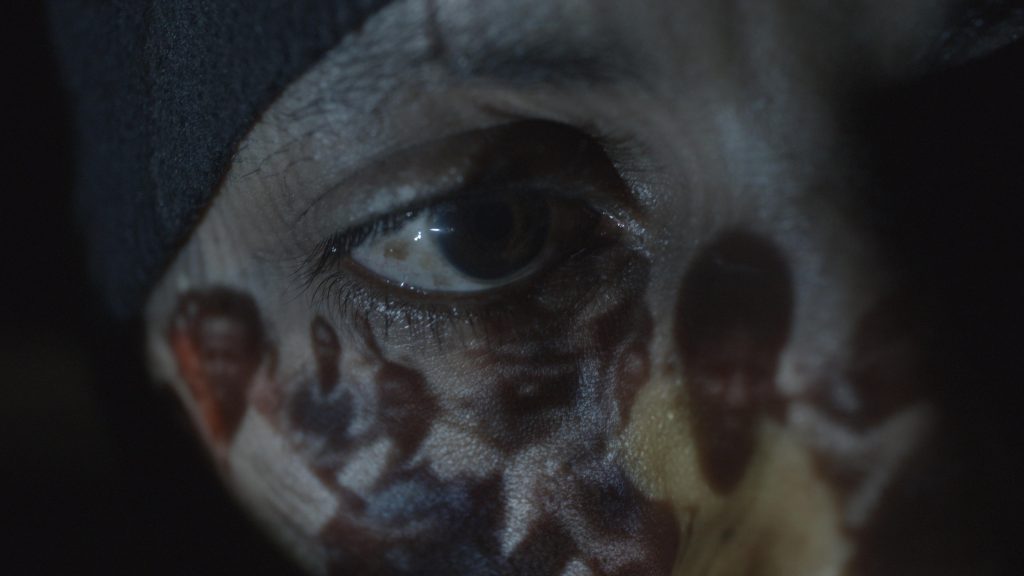
Strategi ketidakserentakan ini diutilisasi Van Lancker dalam menyoal pengalaman melarikan diri para subjeknya, entah dari rezim teror, kemiskinan, hingga perang sipil, dengan mencampuradukkan narasi. Bukan hanya delapan subjek migran dalam film yang kisahnya diverbalkan, namun kesaksian-kesaksian dari para imigran Eropa ke Amerika pada awal abad ke-20 turut diverbalkan oleh para subjek ini. Arsip-arsip yang mendokumentasikan perpindahan manusia diproyeksikan ke bagian tubuh dan menjadi kilatan imaji yang hadir di lubang truk yang membawa para migran. Strategi ini menambah disonansi yang membawa film ini mengeksplorasi pengalaman indrawi dan konteks secara holistik. Exquisite corpse sebagai sistem bahasa film ini bekerja sebagai navigasi persoalan kompleks geopolitik kontemporer yang mewarisi struktur kekerasan lama yang tak kunjung diselesaikan.
Kisah-kisah ini erat kaitannya dengan wahana, secara literal maupun metaforis. Bahtera sebagai wahana yang mengantarkan para migran, baik dalam bentuk kapal kolosal Nuh maupun kapal-kapal reyot dan kapal-kapal karet yang membawa para diaspora yang lari dari negaranya yang berkonflik melintasi Laut Mediterania menuju Eropa. Pertukaran suara dari para migran yang terombang-ambing di atas kapal yang akan tenggelam dengan perespons pertama radio dari negeri yang diharapkan menjadi suaka membuka film dan mengeksplorasi disonansi imaji dan bunyi. Bunyi truk dan kesaksian ini menetapkan atmosfer film yang mencekam di dalam wahana dan berbicara keras mengenai teror yang mengikuti mereka.
Sumber kisah-kisah imigran awal abad ke-20 diekstrak dari Museum Red Star Line, sebuah museum yang didedikasikan pada kapal penumpang trans-Atlantik Red Star Line yang membawa para migran Eropa ke Amerika Serikat untuk memulai kehidupan baru. Terletak di Antwerp, pelabuhan tersibuk di era kolonial, Museum Red Star Line menjadi situs yang memuat paradoks isu migrasi dengan subjek migran kontemporer. Para tokoh berbicara tentang rezim Assad, Taliban, dan kekerasan di Eritrea bercampur dengan kesaksian tentang konflik di Ukraina pada awal abad ke-20. Kontras yang bertemu antara pengalaman diselundupkan dengan lokus yang memuat banyak kontestasi memicu percakapan tentang sejarah migrasi yang tidak dapat dilepaskan dari narasi besar kompartementalisasi.
Strategi yang ditawarkan Laurent Van Lancker dalam film We Others menjadi salah satu pintu masuk untuk membicarakan perkembangan wacana sinema terkini yang erat dengan perkembangan metode ilmu pengetahuan yang semakin mengintegrasikan teknologi audiovisual untuk mencapai epistemologi baru dalam mengurai fenomena geopolitik yang berdampak pada mobilisasi manusia. Barangkali exquisite corpse adalah metode yang tepat untuk menjahit kisah-kisah pembentuk dunia yang beragam. Tanpa menjadi linear dan tunggal, ia mengundang refleksi mendalam karena keberagaman subjek dan daya konstruksi narasi subjek-subjek yang berpartisipasi, dan berpotensi memanggil karena peluang-peluang yang timbul dari kombinasi kesaksiannya. Mungkin selama ini, inilah modus pembentuk sejarah umat manusia.
Daftar Pustaka
Van Lacker, Laurent. “With (in) Each Other: Sensorial Strategies in Recent Audiovisual Work” in Anthropology and Art Practice. Edited by Arno Schneider & Christopher Wright, London & New York: Bloomsbury, 2013.
At what points in human history might we identify decisive moments in human movement? We know the Out of Africa hypothesis, which theorizes successive human dispersals from the African continent; the historical reality of the Columbian Exchange (set in motion by Columbus’s arrival in the Americas in the fifteenth century); and, more recently, the Arab Spring (the overthrow of regimes across the Middle East, which gave rise to numerous civil wars in the twenty-first century). We also encounter such moments in sacred texts: Vishnu taking the form of a tortoise to save humankind from destruction, or the Exodus of the Israelites. All of these form the basis for a collective imagination of the world, or world-building. This collective imagination reorients ideas of humanity, giving rise to systematized violence in the name of enlightenment and civilization.
Colonialism forced its way in, dismantling social orders and the epistemologies of communities that had, for centuries, learned to negotiate conflict and cultivate relationships with the places they inhabited. The colonial mode, which continued through the Cold War, was one of compartmentalization: dividing things into fixed boxes. Vernacular expressions were relegated to the categories of superstition, heresy, and nonsense. The richness of worldbuilding expression–encompassing both narrative and the capacity to construct it–was relegated to a latent collective memory, available to be summoned at any moment yet sometimes forgotten entirely. Preserving this memory became a mode of resistance to dominant powers, one bordering on the mystical. Colonialism rendered these stories of worlds linear and singular. Stories converged, constructing the modern history of human civilization.
At this inescapable juncture, we witness the arrival of recording media from the colonizers’ own world, introducing a new mode of narrative construction. Laurent Van Lancker’s film We Others employs a compelling method for assembling the converging stories of migration: the exquisite corpse. The exquisite corpse, or cadavre exquis in French, is a method that emerged from the Surrealist art movement in early twentieth-century Europe, in which individuals in a group take turns assembling words or images. The method foregrounds intuition and the possibilities of surprise that arise through collective creation. It liberates the process from the social and moral conventions that constrain the individual, allowing the unconscious to emerge in its candor as a way of apprehending phenomena in the world–a central credo of Surrealism. We Others layers the personal testimonies of contemporary migrants inside the vehicle carrying them toward asylum, entangling them with testimonies of early twentieth-century migrants and archival records of migration.
As both a filmmaker and an anthropologist, Laurent Van Lancker’s practice guides him toward shared-authorship. In doing so, he reflects on the practice of another filmmaker-cum-anthropologist, Jean Rouch, who introduced shared-anthropology in the landmark film of world cinema Chronique d’un été (Chronicle of a Summer), in which the participants themselves assess how the filmmakers have represented them. In his first film, Surya (2006), Van Lancker employs his method of shared-authorship to create a sensory documentary through a strategy of asynchronicity (144). Here, asynchronicity refers to the articulation of a distinctive relationship between sound and image that produces sensory experience and knowledge through cinema. Surya became a prototype for Van Lancker’s later films, bringing together storytellers across locations and cultures; asynchronicity became his means of playing with cinema’s codes.
Van Lancker deploys this strategy of asynchronicity to probe his subjects’ experiences of flight–whether from regimes of terror, poverty, or civil war–by interweaving their narratives. Not only are the stories of the film’s eight migrant subjects voiced; these same subjects also voice the testimonies of European immigrants to America in the early twentieth century. Archival images documenting human movement are projected onto their bodies and appear as flashes through the apertures of the truck carrying the migrants. This strategy intensifies the dissonance, enabling the film to explore sensory experience and context as a whole. The exquisite corpse, operating as the film’s grammar system, navigates the complex questions of contemporary geopolitics, which have inherited longstanding structures of violence that remain unresolved.
These stories are intimately bound up with vehicles and vessels, both literally and metaphorically. The ark carries migrants: Noah’s colossal ship, but also the decrepit boats and rubber dinghies that transport displaced people fleeing conflict in their home countries across the Mediterranean Sea toward Europe. An exchange between the voices of migrants adrift on a sinking boat and a radio first responder in the country where they hope to find asylum opens the film, initiating its exploration of the dissonance between image and sound. The truck’s rumble and these testimonies establish the film’s claustrophobic atmosphere inside the vehicle, speaking forcefully to the precarity of displacement.
The accounts of early twentieth-century immigrants are drawn from the Red Star Line Museum, a museum dedicated to the Red Star Line transatlantic passenger ships that carried European migrants to the United States to begin new lives. Located in Antwerp, one of the busiest ports of the colonial era, the Red Star Line Museum becomes a site where the paradoxes of migration converge with the lives of contemporary migrants. The protagonists speak of the Assad regime, the Taliban, and violence in Eritrea, while their accounts mingle with testimonies of conflict in Ukraine in the early twentieth century. The collision between the experience of being smuggled and a locus marked by multiple contestations opens a conversation on the history of migration, which cannot be separated from the broader narrative of compartmentalization.
The strategy Laurent Van Lancker proposes in We Others offers an entry point for discussing current developments in cinematic discourse. These developments are closely tied to evolving methods of knowledge production that increasingly integrate audiovisual technology in pursuit of new epistemologies with which to unravel the geopolitical forces driving human mobility. Perhaps the exquisite corpse is an apt method for stitching together varied stories of worldbuilding. Without reducing them to a single linear account, it invites profound reflection through the diversity of its subjects and the narrative-making capacities of those who participate, while allowing unexpected resonances to emerge from combinations of testimony. Perhaps this has always been how human history is made.
References:
Van Lacker, Laurent. “With (in) Each Other: Sensorial Strategies in Recent Audiovisual Work” in Anthropology and Art Practice. Edited by Arno Schneider & Christopher Wright, London & New York: Bloomsbury, 2013.
Films

Curator’s biography
Luthfan Nur Rochman merupakan seorang pembuat film, kurator, dan penulis, Direktur Eksekutif Forum Lenteng dan Direktur Festival ARKIPEL. Ia pun berfokus di Milisifilem, kelompok belajar produksi film melalui praktik eksperimentasi visual, yang digagas oleh Forum Lenteng dan Candikala, yang mencoba mengontekstualisasikan warisan Hindu-Budha dan kerja arkeologi di Indonesia melalui praktik seni. Luthfan turut mengkurasi beberapa pameran mulai dari pameran tunggal Otty Widasari: PARTISAN (Galeri Nasional Indonesia, 2022), Jogja Fotografis Festival (2023-2024), dan Residensi Seniman dan Festival Rakyat Bangsal Menggawe: Montase Air (Pemenang, Lombok Utara, 2024).
Luthfan Nur Rochman is a filmmaker, curator and writer, Executive Director of Forum Lenteng and Director of ARKIPEL. He also focuses on Milisifilem, a film pro-
duction study collective through visual experimentation practices, initiated by Forum Lenteng, and Candikala, which
tries to contextualize Hindu-Buddhist heritage and archaeological work in Indonesia through art practices. Luthfan also curated several exhibitions, including
Otty Widasari’s solo exhibition: PARTISAN (Galeri Nasional Indonesia, 2022), Jogja Fotografis Festival (2023-2024), and Residensi Seniman and Festival Rakyat Bangsal Menggawe: Montase Air (Pemenang, North Lombok, 2024).